

The quality of the injection molding process depends largely on the filling process and on the ability to create a uniform flow front of the plastic within the mold.
An uneven flow front can lead to weak spots in the material, undesirable weld lines and rejected parts, which in turn reduces the profit when selling the end product.
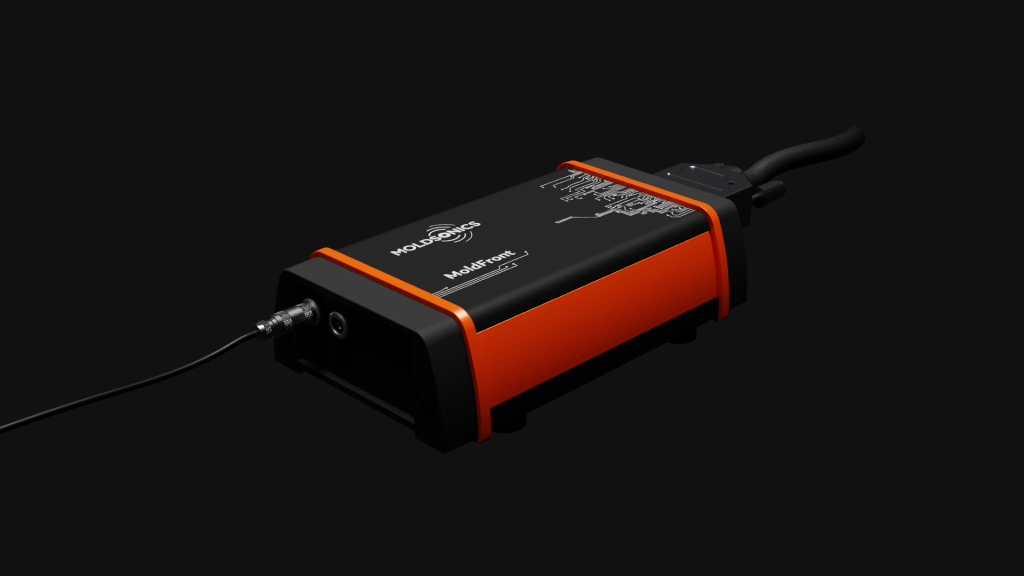
Challenges in flow front detection:
Detecting flow fronts in injection molds is a complex task.
An uneven flow front can be caused by these various factors:
- Changes in material properties
- Tool design
- Changes in the injection molding process
To date, there have been a wide variety of approaches to flow front detection, such as optical sensors, pressure sensors, and temperature sensors. However, these methods have certain drawbacks, such as sensitivity to abrasive materials or limited dynamic range.
A promising alternative to this isnon-contact measurement using ultrasonic sensors.
How ultrasonic flow front detection works:
Ultrasonic flow front detection relies on the continuous transmission of ultrasonic pulses toward the cavity during the injection molding process.
With an empty cavity, 100 % of the ultrasonic energy is reflected at the steel/air interface. If the plastic now hits the measuring point, part of the ultrasonic energy is coupled into the plastic and precisely this difference is subsequently detected by the MoldFront sensor system.
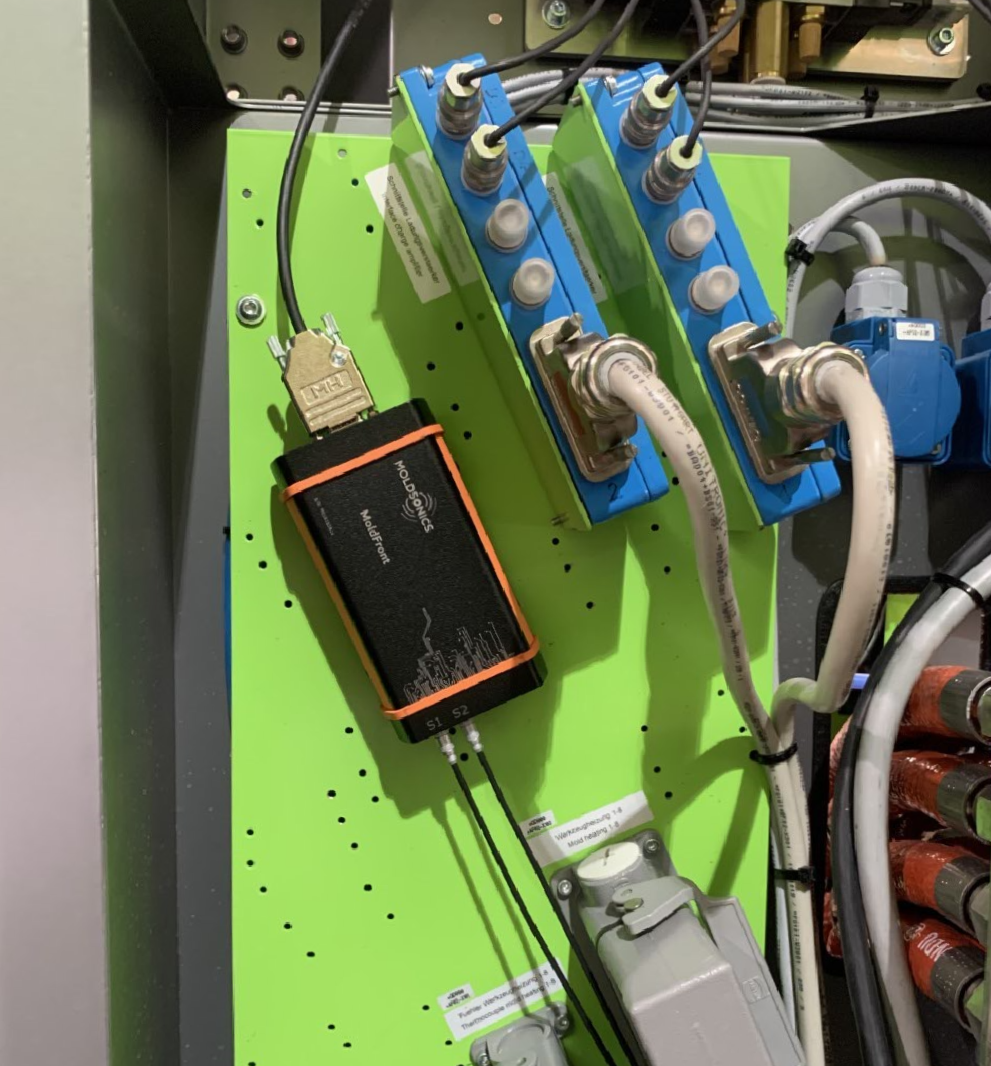
MoldFront electronic unit mounted on an injection molding machine
Click here to view the sensor product mentioned:
Advantages of ultrasonic flow front detection
Ultrasonic flow front detection offers several advantages over other methods:
- Die Methode erfasst dynamisch und in Echtzeit Veränderungen der Fließfront, was eine schnelle Reaktionszeit im Bereich von < 5 Millisekunden ermöglicht.
- The method is resistant to external factors such as abrasive media, high spray pressures, or humidity.
- The method is independent of the material and tool design and can therefore be applied to a wide range of applications.
- This method allows for non-contact measurement at many different points on the tool, resulting in a high degree of design freedom.
Comparison of MoldFront flow front detection and pressure sensors
The use of pressure sensors is a common method for measuring pressure and detecting flow fronts in industry.
The MoldFront ultrasonic sensor technology can be used analogously. While the pressure sensor system measures the increase in pressure in the cavity in order to detect the flow front, the MoldFront ultrasonic sensor system uses density changes in the cavity. This accurately detects whether the steel/air or steel/plastic interface exists at the measurement point. This works equally well for other metals, such as aluminum or copper.
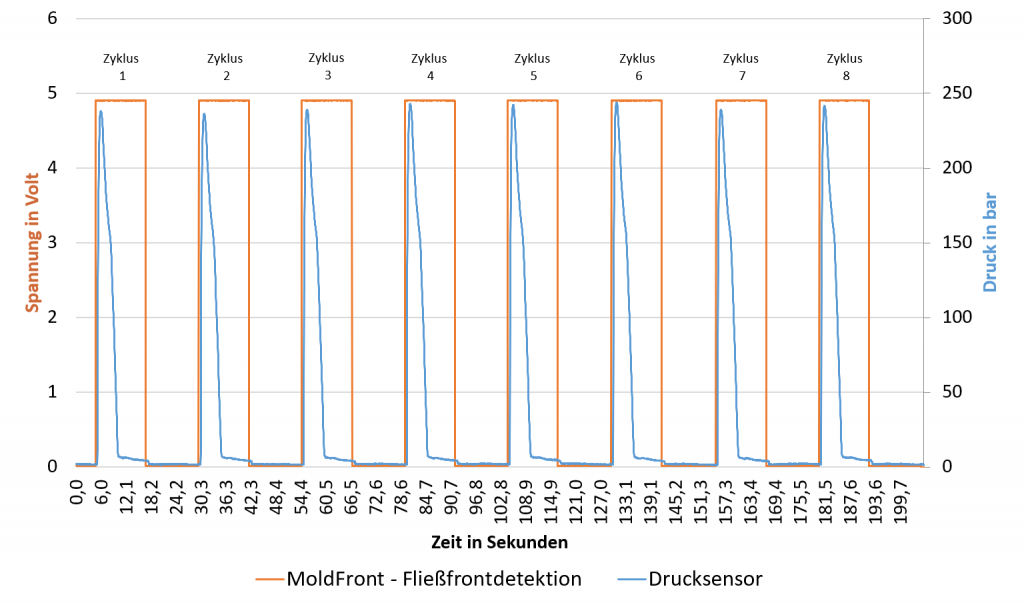
The major advantage of ultrasonic flow front detection is therefore that it allows the flow front to be measured independently of the pressure conditions in the cavity. This means that no response pressure is required, and there is no longer any need to limit the pressure to a specified maximum.
In addition, due to the non-invasive or non-contact measurement, ultrasonic flow front detection can also be used with abrasive media or vacuum applications without any problems.