SENSING & INTEGRATION
Ultrasonic Sensors for Industrial Applications
From compact sensors integrated into molds to direct measurements in the melt channel, Moldsonics develops ultrasonic sensors for a wide range of measurement applications in plastics processing.
We support you with mechanical integration, connection to existing machines, and commissioning — from a single measurement point to a fully integrated machine solution.

Two Sensor Designs for Different Measurement Tasks
Different ultrasonic sensors are used depending on the application. Our compact standard sensor is integrated into tools and machine components. For direct melt evaluation with SonicScan, we use a special sensor design that comes into contact with the medium.
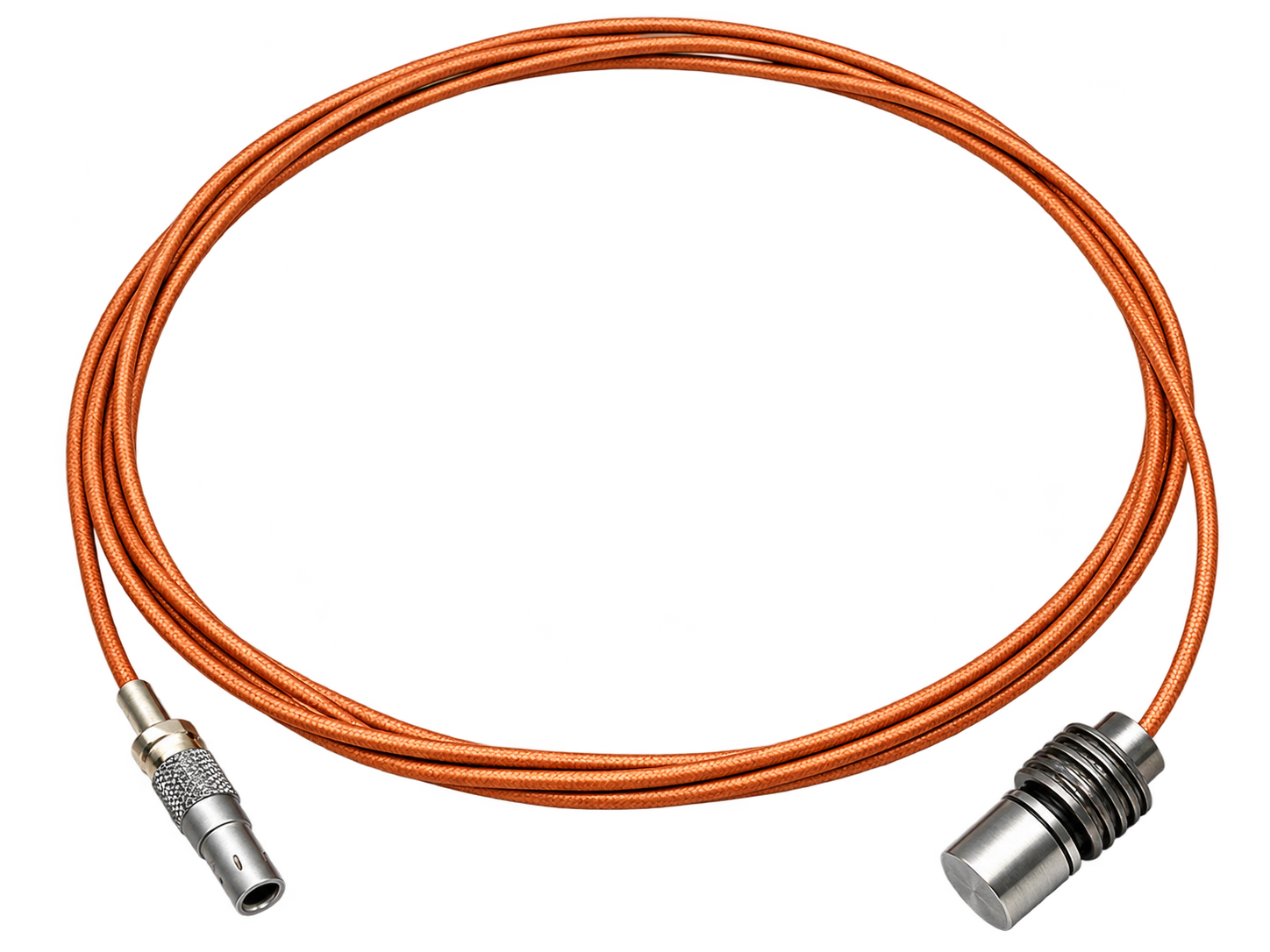
Compact Ultrasonic Sensor
Our standard sensor has a diameter of just 10 mm and a height of 8 mm. This allows it to be integrated into tools and measuring cylinders in a space-saving manner.
- – Sensor diameter: 10 mm
- – Sensor height: 8 mm
- – Cable diameter: 1.8 mm
- – Temperature resistance: up to 120 °C
- – High-temperature version: up to 300 °C
Installation instructions and CAD data are available for mechanical integration.

Sensors for Direct Melt Evaluation
SonicScan uses a special ultrasonic sensor that comes into direct contact with the plastic melt. The sensor has a ½″ UNF threaded connection and is integrated into the melt channel according to the specific application.
Since mechanical integration depends on the specific machine and installation situation, we coordinate the technical design directly with our customers and machine manufacturers.
Are you planning a SonicScan integration? Contact us to discuss the technical details.
Easy to integrate into existing machines and processes
The integration of our ultrasonic sensors is tailored to the specific measurement task. Depending on the application, they are installed, for example, in a bore in the mold, on the plasticizing unit, or directly in the melt channel.
Integration with existing machines and control systems is also straightforward. To achieve this, we use standardized interfaces with digital or analog voltage signals. For direct OEM integrations, communication via OPC UA is also possible.
From selecting suitable sensor locations to commissioning, we support our customers throughout the technical implementation process.

SonicWear – wear measurement
Ultrasonic sensors are integrated at specific measurement points in the plasticizing cylinder. This allows the wear condition of the screw and cylinder to be monitored without having to remove the screw for measurement.

SonicScan – Melt Evaluation
For example, two ultrasonic sensors positioned opposite each other are integrated into a measuring flange and are in direct contact with the plastic melt. The transmission of ultrasonic waves through the melt channel allows the state of the melt to be assessed during the process.

Tool Sensors – Process Monitoring
Our compact ultrasonic sensors are integrated into precision-machined blind holes behind the tool surface. Measurements are taken through the tool steel, without direct contact with the molten plastic.
ELECTRONIC UNITS
Application-Specific Analysis
Our ultrasonic sensors can be used for a variety of measurement tasks. The respective electronic unit and signal processing are tailored to the application and provide the corresponding measurement values or process signals.
Measurements on the plasticizing unit

SonicWear – wear measurement
Ultrasonic-based wear measurement for screws and cylinders—without removing the screw. Suitable for periodic condition assessments and traceable wear trends.
Output / Connectivity: Status and trend data for maintenance planning; depending on the integration, e.g., via digital/analog interfaces, OPC UA, or OEM-specific connectivity.
SonicScan – Melt Evaluation
Evaluates the condition of the plastic melt directly in the melt channel and highlights inhomogeneities as well as relevant process changes.
Output / Interface: Curve profiles and process parameters for melt evaluation; interface options depending on the application, including machine integration, digital/analog signals, or OPC UA.
Measurements in Tools and Processes
MoldFront – Flow Front Detection
Detects, without physical contact, when the molten plastic reaches defined positions in the mold . Suitable for flow front detection and process-oriented event detection.
Output / Integration: Timing and control signals for flow-front events; easy integration into existing machine and control systems via digital signals.
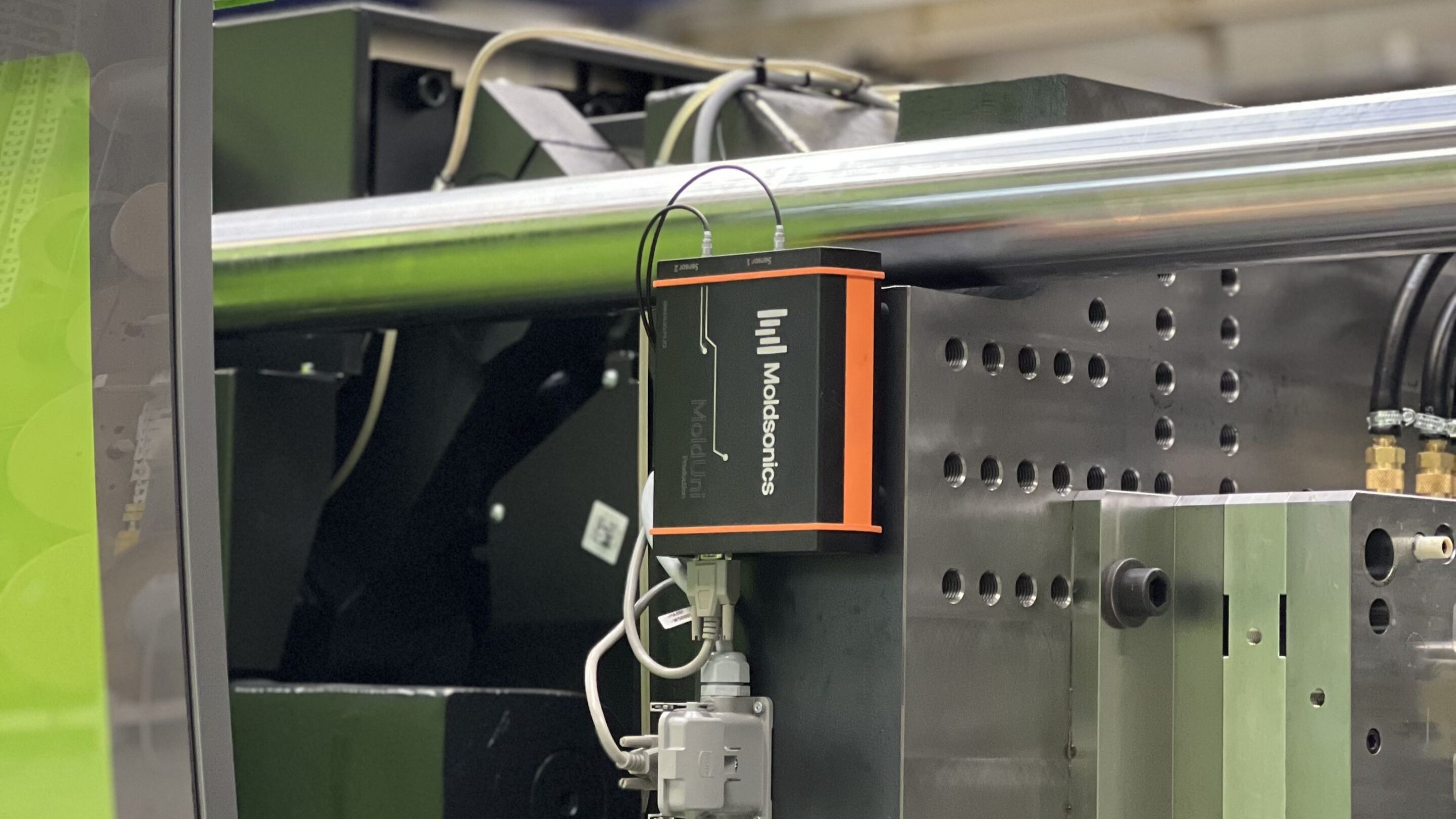
MoldUni – mold- and Process Monitoring
It captures ultrasonic signals from the mold , providing additional insights into filling, release, and cooling processes.
Output / Integration: Time and process information for mold and process analysis; integration into existing machine and control systems via digital/analog signals.
MoldReact – Cross-linking and Curing
Supports the monitoring of curing and cross-linking processes by analyzing material-specific changes in ultrasonic properties.
Output / Connectivity: Process signals and parameters for evaluating reaction and heating processes; application-specific integration depending on the machine and process environment.
From installation planning to commissioning
Every measurement task presents different requirements in terms of sensor positioning, mechanical installation, and machine integration. We work closely with our customers throughout the technical implementation process and help them find the right integration solution.
01 – Check the application
Together, we evaluate the measurement task, the installation situation, and the technical requirements.
02 – Implementing Integration
We provide support in selecting suitable sensor locations as well as in mechanical and electrical integration.
03 – Assist with Commissioning
We assist with the commissioning process and provide support with setting up and verifying the measurement system.
For technical support, we also offer specific service packages such as MoldCheck and MachineCheck. We’d be happy to work with you to determine which package is best suited for your application.
TECHNICAL DOCUMENTATION
Everything You Need for Technical Planning
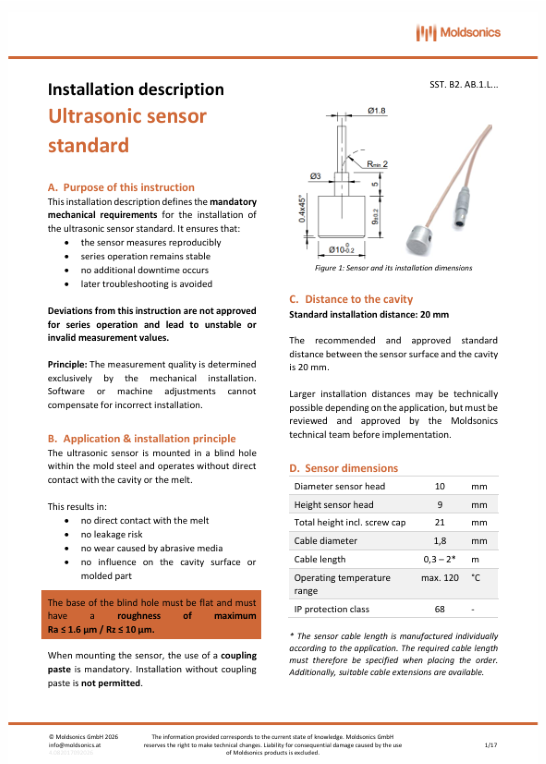
We provide technical documentation for the integration of our standard sensors. You can download the installation instructions directly. CAD data for design planning is available upon request.

Frequently Asked Questions About Sensors and Integration
Answers to technical questions about our ultrasonic sensors, their installation, and their integration into existing machines and processes.
What is the measurement range on the plastic component?
Our ultrasonic sensors operate with a beam angle of approximately 4°. Under typical installation conditions, with a distance of about 20 mm from the cavity surface, experience shows that the range relevant for measurement is on the order of approximately 2 to 4 mm. The actual spatial resolution depends, among other things, on the installation configuration and the specific measurement task.
Where are the sensors typically positioned?
The sensor positions are determined by the information to be captured in each specific process. In the mold, for example, it is common to use a combination of a measurement position near the sprue and one farther from it. This allows for the monitoring of different phases of the filling and cooling process. We tailor the specific positioning to each application.
Are the ultrasonic sensors temperature-resistant?
Our compact standard sensor is available for temperatures up to 120 °C. For applications with higher thermal requirements, we offer a high-temperature version rated up to 300 °C. The appropriate model depends on the actual operating conditions.
Can glass-fiber-reinforced plastics also be measured?
Yes. For glass-fiber-reinforced plastics with fiber content up to about 20%, ultrasonic measurement is generally feasible in many applications. We have also performed measurements on materials with higher glass-fiber content. However, at fiber contents of about 20% or higher, we recommend technical consultation, as measurability depends on the material, component geometry, and measurement task.
What electrical connections are required?
By default, our electronic units require a 24-V DC power supply and a suitable trigger signal from the machine process. The trigger signal is used to associate the ultrasonic measurement with the respective process stage. Additional connections depend on the application and the desired machine integration.
How many sensors can be connected to one electronic unit?
The number of sensor connections depends on the specific electronic unit. Tool sensor systems use two sensors as standard; SonicWear typically uses three sensors; and SonicScan uses two sensors positioned opposite each other. We tailor application-specific configurations on a case-by-case basis.
Are the sensors for reflection and transmission measurements different?
No. Our ultrasonic sensors can be used as both transmitters and receivers. In reflection measurements, the returning echoes are detected, while in transmission measurements, the ultrasonic signal is transmitted between opposing sensors. The specific measurement configuration depends on the application.
Do standard and high-temperature sensors have the same dimensions?
Yes. Both versions have the same sensor dimensions: 10 mm in diameter and 8 mm in height. One of the differences is the cable design. The standard cable has a diameter of 1.8 mm. The version with a metal protective sleeve has an outer diameter of approximately 5 mm.
Can the sensors be retrofitted into existing tools and machines?
Retrofitting is generally possible, provided that suitable mounting locations and the necessary mechanical requirements are met. In particular, the geometry and manufacturing quality of the sensor bore are critical for reliable measurement. We are happy to assist with the evaluation of existing tools and machines.
Do the sensors come into contact with the molten plastic?
That depends on the application. Our standard sensors can be installed behind the tool surface or outside the melt contact area and measure through the steel. For SonicScan, however, we use special, in-contact sensors that are integrated directly into the melt channel.
How are the measured values transmitted to the machine control system?
Depending on the measurement task, standardized digital or analog voltage signals are available. For direct machine and OEM integrations, advanced communication solutions such as OPC UA are also possible. We tailor the appropriate connection to the existing machine control system and the required measurement data.
Are there installation instructions and CAD data available for sensor integration?
Yes. We provide installation instructions for our standard sensors, available for download. CAD data for design planning is also available. For SonicScan and special installation scenarios, we recommend consulting directly with Moldsonics for technical guidance.

Moldsonics GmbH
Hafenstraße 47-51
4020 Linz, Austria
info@moldsonics.at
Legal Notice
Privacy Policy
Terms and Conditions
Copyright 2026: Moldsonics GmbH
All rights reserved

Supported by: